

Back in March 2024, Google’s core update rolled out quickly and smoothly. Shortly after this, 837 websites were completely removed from its index from a monitored sample of 49,000 websites. This was followed on with another update in August with similar effects. The reason behind this targeted culling remains a terribly important point to consider.
Every single one of these sites contained AI-generated content, with half of them consisting of 90-100% machine-written material. The impact of this lead to a loss of over 20 million monthly organic visits and nearly half a million in monthly advertising revenue. Jump forward to today and AI content now comprises 19.10% of Google’s search results – which is an all-time high, up from 2.3% prior to GPT 2 – and despite being somewhat of a contradictory outcome to Google’s March and August purges, it actually demonstrates how Google treats AI content.
At the base of all of this is a rule that needs to be understood well – that AI is a tool, not a replacement for human expertise and creativity. When we examine Google’s pretty steadfast stance, it becomes clear that their target isn’t AI itself, but instead the flood of low-quality, unoriginal content cluttering our search results. This is understandable too, as there is a real fear now of AI scraping material from it’s own making. If that becomes prevalent, then true originality and that essential human connection withers away.
Now, before you label this article as a rant that spells doom for AI in content creation, I’d like to clarify that this is actually an intricate look at how AI is impacting your content in general, as well as your site’s SEO. And before the worry sets in too deeply, I should reiterate that Google’s position isn’t about condemning AI outright – it’s about maintaining content quality regardless of how it’s produced.
What’s unfolding isn’t the death of AI in SEO, but rather a clarion call for a more intimate and sophisticated approach to content creation.
Why Search Engines Are Getting Smarter

When half of the websites Google removed contained nearly pure AI content, it became clear that search engines were ruthless in their scoring. This step back from full automated content isn’t random either; it’s a clear and calculated response to preserve search quality through increasingly smart detection methods.
It’s worth remembering at this point that Google is a business and will therefore move in a direction that’s best for their users. It will prioritise well thought out, high quality content, as that’s exactly what their users want.
Elizabeth Tucker, Director of Product for Search at Google, emphasised that Google’s update was more complex than typical core updates, integrating the ‘helpful content’ system directly into core ranking algorithms. The immediate impact was notable to say the least, with analysis showing widespread effects across major publishers. Sistrix data revealed that 55 out of 70 leading publishers lost search visibility, with some experiencing dramatic drops:
• Screenrant: Largest drop at 40% (from 27.6 to 16.7 points)
• BBC News: 37% decrease (from 24.7 to 15.4 points)
• Evening Standard: 32% decline (from 29.6 to 20.1 points)
• LBC: 30% reduction (from 1.3 to 0.9 points)
• Daily Record: 24% drop (from 4.6 to 3.5 points)
Since the rollout of this update, similar trends show that it is not down to how content was created, but purely about the content itself. Is it new? Is it regurgitating old content? Is it helpful? All of this will need to be considered when using AI for content creation (especially written AI content).
So, we must then ask (at a point where the speed of AI is progressing drastically in every way) how can content be screened and analysed properly and fairly?
How does Google decide what is spam?
At the technical epicentre of Google’s planning sits SpamBrain, Google’s AI-powered spam prevention system. A stiff-nosed warden of sorts, that analyses your content before it even enters Google’s index. Since 2022, this platform has become supremely adept at identifying unwanted content, with Chris Nelson’s search quality team specifically focusing on ‘detection and treatment of AI-generated content’.
The system’s capabilities are actually quite remarkable – it’s achieved a 500% increase in catching spam sites compared to previous years, while improving detection rates for hacked websites by tenfold. But what’s truly fascinating is how SpamBrain learns and adapts. It covers obvious spam signals and analyses new patterns, unusual behaviours and multiple types of abuse. The system has become so effective that Google reported it now prevents 99% of spam results from appearing in search results.
SpamBrain’s learning capabilities mean it’s continuously adapting to new data, enhancing its detection capabilities with each passing day; and considering this update was in March last year, that’s a lot of time to study. The system has even enhanced its ability to identify link spam, detecting 50 times more link spam sites than before – a clear indication of how sophisticated these detection methods have become.
What makes this particularly relevant for when we create content is that SpamBrain doesn’t just target obvious spam. It’s specifically designed to identify and evaluate content quality issues, including subtle SynthID markers that might indicate AI-generated content violating Google’s guidelines. This means the bar for content quality is continuously rising.
What is SynthID?
The technological arsenal to deal with this epic challenge has, unsurprisingly, expanded significantly too – with SynthID now available as open-source technology. This system embeds invisible digital watermarks directly into AI-generated text, making it possible to identify a content’s origin (but without compromising its quality).
What’s fascinating is how this technology modifies the probability scores of generated text tokens, creating a unique pattern that serves as a digital fingerprint. However, many have argued that this process isn’t a definitive solution, merely a step in the right direction.
When we look at current detection capabilities, we are shown a desperate need for this issue to be addressed head on. While Originality.ai claims a 99% accuracy rate with their latest model, particularly excelling at identifying edited AI content, Scribbr’s premium detector achieves 84% accuracy with notably low false positives.
These tools, along with several others in action, represent the best defence against low-quality automated content. Although, they’re likewise constantly evolving to keep pace with increasingly sophisticated and advanced AI writing. It’s a case of 2 steps forward, 1 step back.
These platforms are also very sensitive in picking up content that has been planned using AI. For example, a post that is planned and researched using ChatGPT but 100% manually written will likely be flagged as AI. Your input is required at every step of the way to balance this out.
Are New AI Content Laws Affecting SEO?

California’s newest AI legislation (effective January 2025) has had a global impact on our approach to content marketing. The law now requires clear disclosure of AI-generated content, with specific emphasis on realistic images, audio and video. It’s a move that is, right now, adapting our content strategies for a more transparent digital presence.
This particular reach extends to any business with over 1 million monthly users, requiring them to implement AI detection tools and include both visible and metadata disclosures in AI-generated content.
The impact is particularly notable as California hosts 32 of the world’s 50 leading AI companies. UK enterprises doing business with European or American consumers will need to understand these requirements intricately, especially since the UK’s own AI regulations remain somewhat in the dark.
This means small to medium-sized UK businesses currently face no mandatory disclosure requirements for AI-written content. However, visual content – including images, videos and audio – must follow stricter transparency guidelines regardless of audience location. If you’re using AI tools or services from California-based companies (which include most major providers), you’ll need to comply with their transparency requirements, particularly if your content reaches American audiences.
The UK government is currently consulting on proposals that would allow commercial use of copyright works to train AI models while providing rights holders with an ‘opt-out’ option. This consultation remains open until February 25, 2025, suggesting we’re likely to see more defined regulations emerging throughout the year.
For now though, the focus remains on preventing deceptive practices rather than regulating all AI-assisted content creation.
What are the legal issues of AI in social media?
If we look at how major platforms have already responded to this you’ll see this trend unfold. YouTube is rolling out synthetic-singing detection technology, while TikTok has implemented mandatory AI content labelling (although what with the ban in America, things are up in the air). Meta’s approach goes even further, working with industry giants like Google and OpenAI to develop universal technical standards for identifying AI-generated content. While X has been quiet on this topic, it’s likely that they too will take similar steps.
The key point to takeaway is that more regulations will surely follow, making sure that high quality content is created with humans very much in mind.
Will SGE Replace Traditional Search Results?

Google has also thrown another spanner in the works when it comes to SEO. More specifically, their Search Generative Experience that came into effect in May last year. These, as I’m sure you are aware by now, are AI generated responses at the top of SERPS. This supports the idea of Google changing direction and committing to better user experiences – providing more direct, helpful content immediately.
Needless to say, SGE’s introduction has notably affected click-through rates for organic results; particularly for queries where a quick AI summary might suffice a user’s needs. Having said this, traditional organic listings are not disappearing, and I’ll explain why.
While SGE occupies a prominent space on the results page, it often offers AI-generated summaries without the need to click away to external websites; and this is the point to remember here. SGE responses will be short, direct and often lacking depth. To me, this indicates that traditional search results still serve a vital role – especially for more complex or transactional queries where users might seek more in-depth information. This is where we must focus our attentions.
How Should Content Be Optimised for SGE?
This year, your content (on top of what we have already discussed) should include the following aspects to be more noticeable to Google – thereby increasing your chances of being included in SGE responses and top pages.
- Comprehensive and factual content: Focus on answering more specific questions users might have, ensuring the content is both broad and deep in scope (more on this later).
- Structured data and clear headings: Use schema markup and well organised content with correct headings to help AI understand and display your content more effectively.
- Original insights and research: Content that provides unique value or new perspectives is more likely to be featured or linked in SGE results.
- Conversational language: Write in a way that mirrors how users might ask questions or how they speak naturally, fitting in more with the conversational nature of SGE queries.
How Can AI be Used for Content Creation?

If your small business is using AI (and it should), your content strategy should start by establishing clear brand voice guidelines for AI tools and implement a multi-level review system that balances automation with human expert judgment. Remember, the goal isn’t to hide AI usage but to use it transparently and effectively.
People won’t mind that you’ve used AI for research or structure, but they will mind if no effort has been put into the content they’re reading. Your AI content will impact SEO if it’s overused, heavily relied on and published without your input.
You also need to consider your audience first. These are your potential clients and are likely to spot AI content a mile away. They’ll get bored if the content isn’t helpful. Raising the quality of what you provide not only shows your capabilities, it also shows how dedicated you are to helping your readers. There’s a few steps to help with this:
Quality control of AI content
Quality control should demand more than just basic proofreading and copy editing. Consider implementing regular quality checks with specific benchmarks that directly impact your content’s performance. More than that. Your content has to hold an emotional kick. It needs to connect on that deeper level to really keep engagement levels up.
As a general rule, get your readability scores around 60-70 on the Flesch-Kincaid scale. This is where your content becomes accessible to the widest possible audience while maintaining the sophistication needed for professional topics. This isn’t always the case, but it’s still good practice.
Factual accuracy
Maintaining 99% accuracy quickly helps with building unshakeable trust with your audience – it’s always needed. This benchmark represents the highest achievable verification rate while keeping your content production efficient.
Studies show that implementing rigorous fact-checking can boost your content’s factual accuracy rating by nearly 0.6 points on a 5-point scale, significantly improving your content’s authority and trustworthiness.
Plagiarism
Maintaining 99% accuracy quickly helps with building unshakeable trust with your audience – it’s always needed. This benchmark represents the highest achievable verification rate while keeping your content production efficient.
Studies show that implementing rigorous fact-checking can boost your content’s factual accuracy rating by nearly 0.6 points on a 5-point scale, significantly improving your content’s authority and trustworthiness.
Know the rules
To mitigate the risk of low quality effectively (and what is classed as low quality), you’ll also need to stay ahead of regulatory changes, which are likely to change often. Establish robust data governance protocols, maintain detailed documentation of AI usage (for larger businesses) and regularly audit your content creation processes.
Think of risk mitigation as ongoing too, where your team, your digital marketing tools and your planning adapt to changes – changes that will inevitably continue as technology and regulations advance.
E-E-A-T Quality Over Quantity
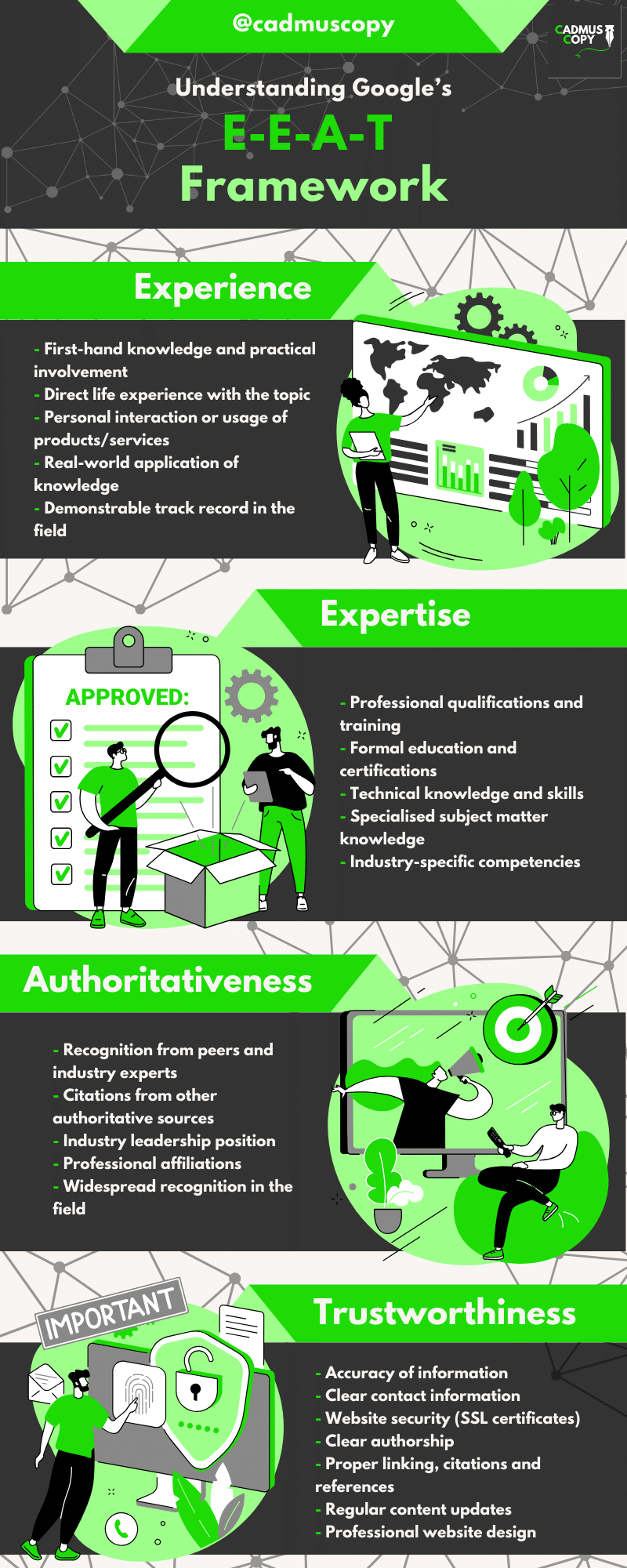
Trust, as I’ve drummed home, is such an important element to consider when understanding Google’s content evaluation system. Without it, even material backed by substantial experience or expertise falls flat on its face. You could argue that this is the most important aspect of your content; which is a good thing ultimately, as it is getting us to think deeper about what truly matters to our audiences.
Experience, added to the E-E-A-T framework in 2022, demands first-hand knowledge and real-world participation. When you write about a topic, whether it’s an in depth restaurant review or a technical tutorial, you need to have truly lived it. Stories of your hands on experience work wonders here and this personal touch separates authentic content from surface-level observations.
What is Authoritativeness in SEO?
Authoritativeness works hand in hand with Expertise to establish credibility. Think of expertise as your content foundation – your qualifications, training and deep understanding of your subject matter. Authority builds upon this through recognition from others in your field. Together, they create a compelling signal that tells both users and search engines that your content deserves some attention. It demonstrates that your website is a trusted and reliable source of information.
In order to achieve this though, human oversight plays a inescapable role in maintaining these high standards. While AI can quickly assist in content creation, your expertise must verify accuracy and add genuinely valuable insights. This combination of efficiency and human wisdom helps ensure your content meets both user needs and search engine requirements. It allows for far more impactful content.
In short, the value you add must be substantial and unique. Simply repackaging existing information won’t work. Your content needs to offer fresh perspectives, original research, or practical insights that aren’t readily available elsewhere. When crafting your content, ask yourself, what unique angle or insight can you provide that others haven’t? What makes your perspective particularly valuable to your audience?
Once you have this figured out, you’re well on your way to creating effective, valuable content.
Partnering with a Content Marketing Professional
When implemented thoughtfully, AI-enhanced content can, without a doubt, thrive under Google’s increasingly harsh evaluation systems. The key is balancing it strictly with your own insights and expertise, your own innovation and authenticity.
If that is something you don’t feel comfortable doing, reaching out to a content marketing professional should be your next step. We’re entering a new phase in digital marketing where the road ahead is a little cloudy. In these situations, we can focus on the information we have and construct solid plans from there. It’s the role of a content marketer to understand these changes well and how they affect your SEO. They know what’s effective and utilise the technological tools that are available.
Of course, if you wish to take things on by yourself, there’s a few tips to help you. Firstly, start small and aim big. Rather than diving headfirst into full AI integration and creation, begin with targeted applications in research and initial drafting while maintaining strong hands-on oversight. Your content strategy should change like a living organism would – growing, adapting and becoming more sophisticated as your understanding of these tools deepens.
Your priority this year is to craft content that genuinely connects with audiences on a deeper level. You need to build trust at a time when people are increasingly skeptical. It’s becoming clear that there’s too much low quality content online offering quick wins, shallow effort and heartless approaches.
This is what Google is trying to avoid. They are pushing forward businesses that show a genuine effort to help – in their content, their services and in their ability to connect with people.
While SEO called for different tactics before, it’s clear that big steps are being made to rectify past mistakes. SEO work is focusing heavily on user experience and truly helpful content.
If you can do this well, with AI beside you rather than in front, then your content will be far more effective and far more appealing to your audience – and therefore Google too.
Helping you connect and grow
Whether you’re business is just starting to explore AI integration or looking to refine your existing strategy, Cadmus Copy can make your written content and digital presence far more authentic and impactful.
Book a discovery call today and see how we bring authenticity back on the table, turning you into a thought leader who’s always trusted and relied upon.
Other resources
SEO in 2025 by David Bain

SEO in 2025 offers truly helpful insider knowledge, where 106 top SEO minds share their single best strategy for the upcoming year – and beyond.
It’s packed with experienced insights and tips on everything from harnessing AI, focusing on user experience, to elevating content quality and technical SEO, ensuring you’re setting the pace for what lies ahead. If you want the full breakdown, this is a great read.
3 responses