

The Wolf, The Witch and The Grave Robbers
The word ‘Halloween’ originates from ‘All Hallows’ Eve,’ – it’s a contraction of ‘Hallow’ (meaning holy, or saint) and ‘e’en’, a Scottish abbreviation of evening.
The origins trace back over 2,000 years to the Celtic festival of Samhain (pronounced ‘sow-win’), which marked the end of the harvest season and the beginning of a cold winter. The Celts believed this time blurred protective boundaries between the living and the dead, allowing spirits to cross over.
As Christianity spread, the Church attempted to replace pagan festivals with Christian elements. In the 8th century, Pope Gregory III designated November 1 as All Saints’ Day, making October 31 All Hallows’ Eve. Over time, these traditions blended with Samhain customs, creating the Halloween we know today.
Halloween traditions like trick-or-treating, costume-wearing, and pumpkin carving have interlacing roots in various cultural practices. It’s likely that the custom of wearing costumes may stem from the Celtic practice of dressing in animal skins to ward off spirits.
So, considering that Halloween is fast approaching, we jumped on this opportunity to explore the spine tingling past of our home in Elgin. This busy town is filled to the brim with history that spans well over a thousand years and anything this old is bound to contain some pretty bone-chilling stories.
Within 5 minutes of research, it’s clear that Elgin’s past contains grandeur, mystery and an unbreakable community spirit.
It’s seen the rise of magnificent cathedrals, weathered fierce bloody clan battles and even welcomed royalty within its bounds – who have basked in it’s scenic beauty, far reaching forests and unique climate. It’s an inspiring place where the remains of Pictish settlements meet with the whispers of medieval glory, and epitomised by a steadfast defiance.
We’ll show you a picture of real events that have shaped the very character of this town. So, welcome to Elgin – where every stone has a story (almost literally) and every shadow might just hide a devilish secret.
We’ll tell of the tyrant Wolf of Badenoch who used fear as his greatest weapon, of a Witch who escaped torture, a cold blooded murder, and of the eery practice of body snatching from the cathedral grounds. Each tale adding to Elgin’s already fascinating history.
Just perfect for fireside stories this Halloween!
The Wolf of Badenoch

Elgin’s history is impossible to explore, without stumbling on one of the most infamous figures in Scottish history, Alexander Stewart, Earl of Buchan – better known as the Wolf of Badenoch. A tidy name for a very real villain.
It might be a little confusing, how a royal prince could earn such a Bond-esque title, but his actions in 1390 would forever cement his reputation as a truly hateful and vengeful man.
Alexander’s reputation for cruelty preceded him like a foul wind. Peasants would whisper of homes being reduced to cinders on his unpredictable whim; of men and women vanishing into the depths of his dungeons with little provocation. The Wolf’s appetite for power and pleasure was insatiable, and he gorged himself on both with a reckless craze.
Why did the wolf of Badenoch burn Elgin Cathedral?
In the year 1389, The Wolf had grown weary of his wife, Euphemia, Countess of Ross, and cast her aside for his mistress, Mariota Athyn. This brazen act drew the anger of the Bishop of Moray, who ruled against Alexander in the ensuing dispute. The Wolf was angered by this challenge to his authority and in May of 1390, he unleashed his fury upon the town of Forres, leaving it a smouldering ruin.
But this was just the beginning. Before the end was out, the Wolf gathered his ‘wild wykked Heiland men‘ – a horde of Highland warriors loyal only to him and gold – and set his sights on Elgin.
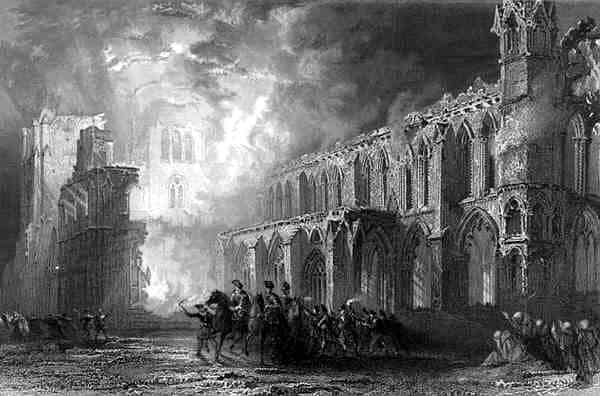
Elgin, with its magnificent cathedral (known as the Lantern of the North) stood as a true beacon of knowledge and progression in the Highlands. The Wolf and his men descended upon the town, the air filled with screams and the acrid stench of smoke as they put torch to nearly every building of significance.
The cathedral, that had taken centuries to build, was reduced to a blackened shell in mere hours. Pluscarden Abbey, Greyfriars monastery, St Giles Church – all fell victim to the Wolf’s wrath. Even the Hospital of Maison Dieu, a place of healing and mercy, was not spared from the flames.
The full extent of the devastation in Elgin became clear. The Wolf of Badenoch had struck a cruel blow against the very heart of culture and learning in northern Scotland.
The repercussions of this act were swift and severe. The Bishop of Moray pronounced Alexander Stewart excommunicated – cast out from the protection and salvation of the Church. Even the Wolf’s royal blood couldn’t shield him from this spiritual condemnation.
Faced with the gravity of his actions, Alexander was forced to make amends. In a scene of public humiliation, he appeared before his brother, King Robert III, dressed in sackcloth – the garb of penitents. This display of contrition, however genuine or forced, was enough to earn him absolution and readmission to the Church.
Where was the wolf of badenoch buried?
The death of Alexander remains another mystery, with some tales saying that he was found dead after losing a game of chess with the Devil, his face contorted through fear. Other tales aren’t quite so fanciful.
However he died, his is buried in the Tomb of the Wolf of Badenoch, located in Dunkeld Cathedral, Perthshire, where the horrors of his acts remain chillingly present.
The attack on Elgin stood as a stark reminder of the brutal realities of power in medieval Scotland. Alexander’s legacy would forever be tainted by this act of heartless destruction, his name synonymous with the worst excesses of feudal tyranny.
The Witch Who Lived
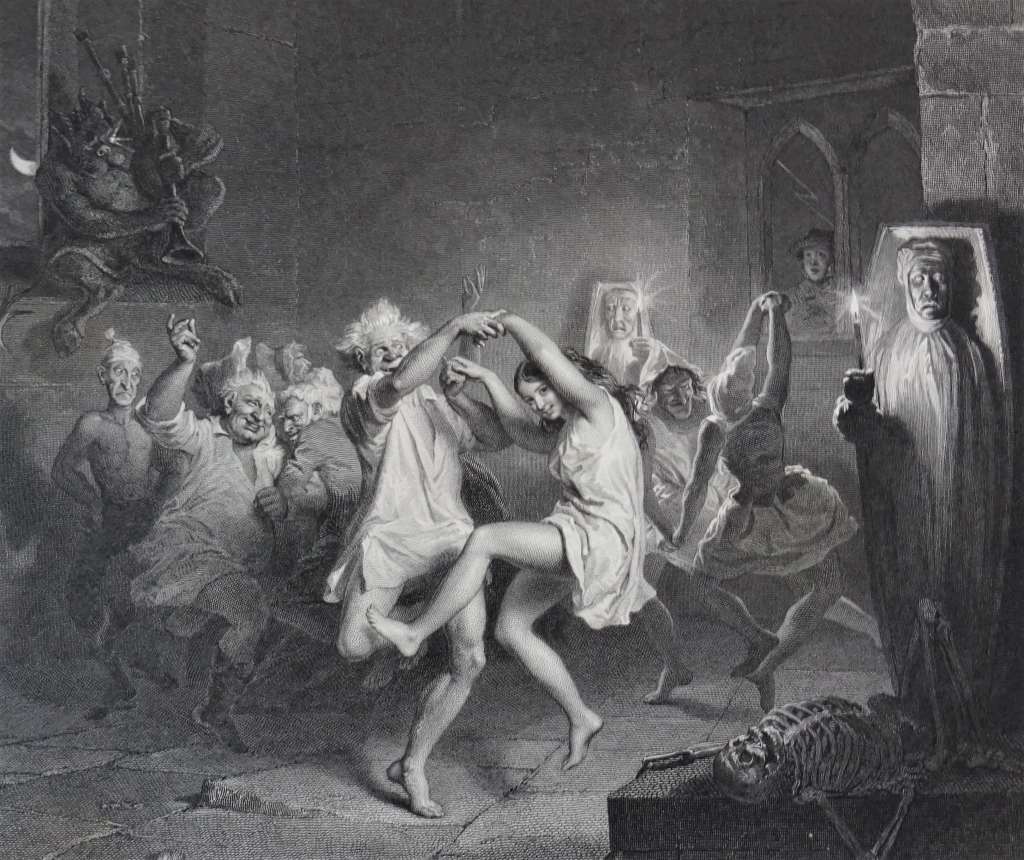
In the 17th Century, the histories of Europe and America were stained with the blood of thousands accused of consorting with the devil. Scotland, it seems, was no different, where over 3000 souls found themselves in the crosshairs of witch-hunters – their fates quickly sealed by cruel whispers and pointing fingers.
Jane Wishart’s case in 1596 was particularly notable. Witnesses reported hearing strange rumbling noises coming from her home, which frightened her neighbour who feared his house might collapse. This was taken as evidence of her supernatural powers. Janet was convicted of 18 counts of witchcraft and, along with her son Thomas Levis who was accused of sorcery, was strangled and burnt according to city archives.
Elgin was not spared this madness. The Scottish Witchcraft Database, a grim ledger of the accused, lists 26 unfortunates from Elgin alone. Among them, we find the tale of Janat Cuj, standing before her accusers. The charges against her were causing illness and robbing folk of speech after heated words were exchanged.
You can almost hear the desperation in Janat’s voice as she denied these fantastical claims. But, the truth barely mattered. She was confined for ‘private confession and prayer’ – a euphemism, no doubt, for less than gentle persuasion. A common cruelty in this time, forcing a confession by torture.
But Janat, it seems, had a spark of defiance that summarises the spirit of the Highlanders. In a twist worthy of its own tale, she managed to slip away from her captors, vanishing into history. One can only imagine the fear that must have dogged her steps as she fled, knowing that to be caught meant certain death.
The Witches in Macbeth
Shakespeare’s Macbeth, set in 11th-century Scotland (but written in the early 17th century) features three witches who prophesied Macbeth’s rise to power and ultimate downfall. They are called the ‘Weird Sisters’ who draw more on earlier folklore and superstitions about witchcraft that existed long before the witch trials began in Scotland.
However, the presence of the witches in the play reflects the fear and fascination with witchcraft in Shakespeare’s time, which would soon lead to the witch hunts that gripped Europe in the following decades. Macbeth therefore, can be seen as foreshadowing the witch trial era, rather than being influenced by it.
The concept of three female figures who can foresee and influence destiny actually has deeper roots in ancient Greek mythology. The Moirai, or Fates – Clotho, Lachesis and Atropos – were said to control the thread of every mortal’s life from birth to death.
Today, you can embark on several Witches Tours in Elgin which are highly recommended; an example of our fascination with the macabre and our deep appreciation of old stories told anew.
The History of The Witches' Stone
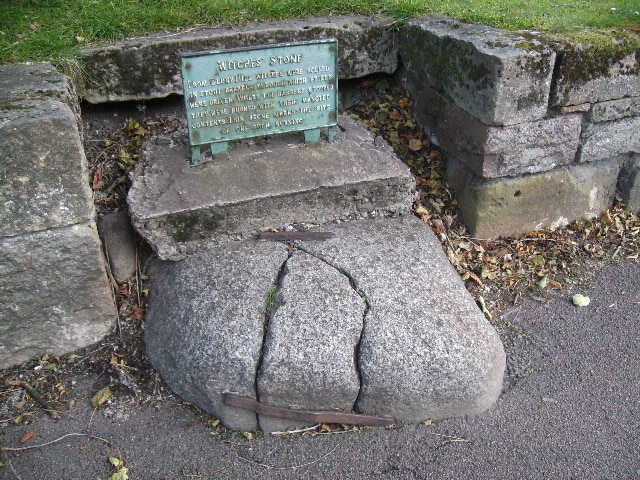
Not far from Elgin, in the town of Forres, stands a grim monument to this period of terror. The Witches Stone, a hulking boulder at the foot of Cluny Hill, is a stubborn reminder of the time.
At the summit of the hill, an accused Witch would face a crowd. People she knew, who she had spoken with and played with as a child, all gathered to witness ‘justice’ being served. A barrel studded with long spikes awaits. The accused is forced inside – someone’s mother, sister, or daughter. And then screams, as the barrel begins its terrible descent.
The sign accompanying this stone paints a vivid picture – where the barrels finally came to rest, fires were lit and those inside, alive or dead, would be burned. These weren’t isolated incidents, mind you. Across Europe, similar scenes played out with regularity. Families were torn, communities poisoned by suspicion and fear. Most of the accused were not mysterious outsiders, but settled folk – often older women who’d spent years building reputations.
It’s a sobering thought, how easily fear and ignorance can corrupt societies. How quickly we can turn on our own, sacrificing reason and compassion on the altar of superstition and ideology.
By remembering Jane, Janat and the other victims of the witch trials, we honour their memory and steel ourselves against the ever-present temptation to let fear rule us.
The Turnpike Murder

On a bitter December evening in 1833, as the sun dipped below the horizon and darkness crept across Moray, a gruesome tale began to unfold on the old turnpike road between Elgin and Lhanbryde. This story, etched into local history, would come to be known as the Turnpike Murder.
William Ritchie, a man of humble means but honest toil, had spent the day ‘trenching ground’ at Lesmurdie Cottage, owned by a certain Captain Stewart. As the clock struck five, Ritchie began his weary route home to Lhanbryde, where his family awaited his return. This familiar journey would happen to be his last.
Between five and six o’clock, the stillness of the winter evening was shattered by a brutal attack. Ritchie, ambushed on the lonely road, fell victim to a violent assault. The violence of the attack was evident in the ‘dreadful fractures’ that covered his skull, a testament to the ferocity of his assailant.
Fate, it seemed, was not entirely cruel that night. Two passersby, drawn by agonised groans emanating from a roadside ditch, discovered Ritchie clinging to life. But the reprieve was brief. After a few laboured gasps, Ritchie died, leaving behind a mystery that would grip the community.
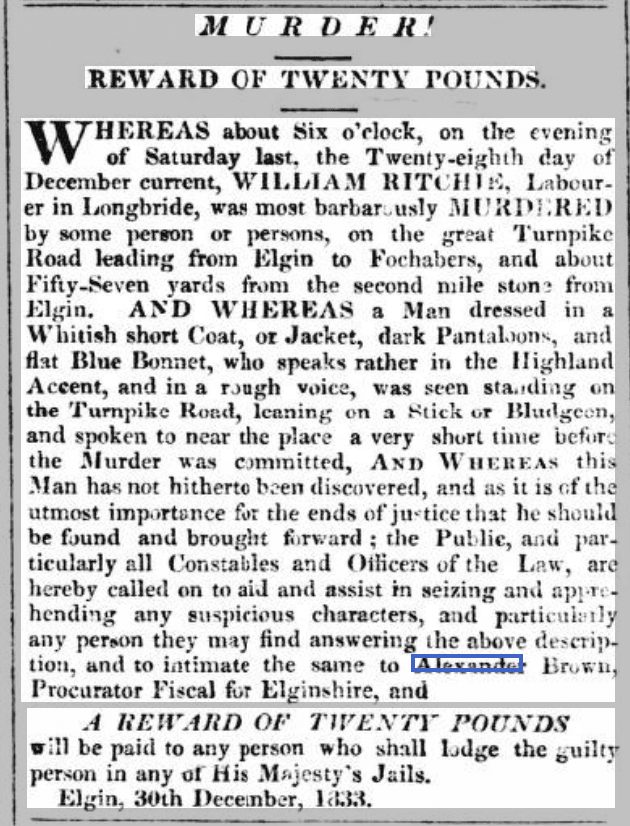
The local authorities sprang into action with a vigour that would have impressed Sherlock Holmes. Procurator Fiscal Alexander Brown and Sheriff Cameron orchestrated a manhunt of impressive scope. Search parties combed the countryside, witnesses were meticulously questioned and a princely sum of twenty pounds was offered for information leading to the culprit’s capture.
Their diligence bore fruit when they apprehended William Noble, an army deserter. No stranger to the inside of Elgin jail (which doubled as an old toll booth), Noble had recently served time for theft. Upon his release, he was due to face a court martial for desertion. Instead, he had vanished into the Moray countryside, seeking work and, perhaps, anonymity.
The Trial of William Noble
The trial, held at Inverness Circuit Court, was a spectacle of high drama. Noble vehemently protested his innocence. But the evidence mounted against him. Jessie Smith, a servant at Fernyfield, delivered damning testimony, identifying Noble as the man she’d encountered on the road that night.
We found that a ‘Courant reporter of 182 years ago‘ wrote:
After he got himself seated, he turned his head to a direction where he heard a bustle amongst the crowd and saw his father endeavouring to get over to him.
The old man, who had not seen him since his committal, appeared very much affected and said, ‘Willie, give me your hand’.
Young Noble extended both his hands to him as he was handcuffed, and seeing that his father was crying, said: ‘Never fear, father’.
Despite an impassioned plea from his legal counsel and a jury recommendation for mercy, the verdict was inexorable. Noble was found guilty and sentenced to death. On May 31, 1834, Elgin witnessed its first execution in decades.
The murder on a well-traveled road between two closely connected towns briefly shattered the comfort of rural safety. But, in adversity, the people of Elgin found more unity and resilience.
A curious footnote to this tale emerged in the form of a beech tree near the murder scene. It became a focal point for local superstition, with passersby flinging stones at its trunk to ward off ill fortune – a practice that speaks volumes about the deep impression left by the Turnpike Murder on the inhabitants nearby.
As years turned to decades, the story of William Noble and William Ritchie refused to fade from memory. It became a cautionary tale, a fireside story, a reminder of a night best left to the past.
The Grave Robbers!
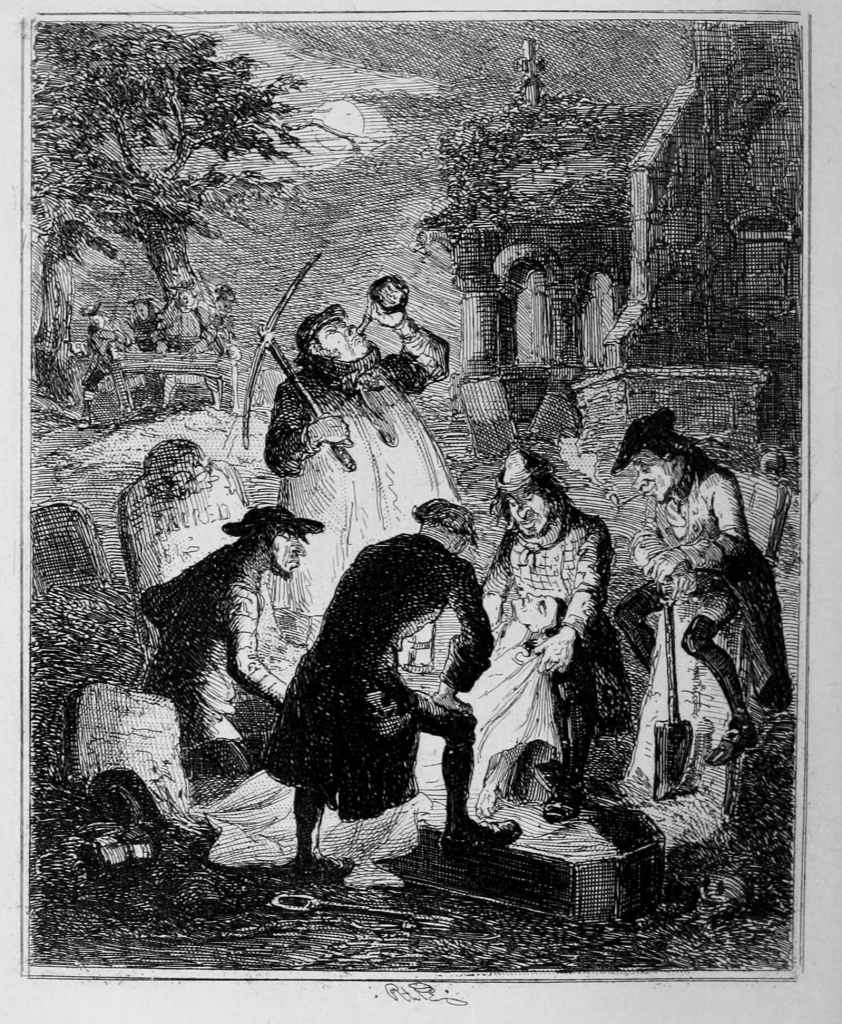
In the early 19th century, a sinister trade cast its shadow over the hallowed grounds of Elgin Cathedral. The ancient stones that had stood sentinel over countless generations met with a new and ghastly practice: body snatching. This macabre business, born of medical necessity and moral ambiguity, turned graveyards across Scotland into hunting grounds for the so-called ‘resurrectionists‘.
For in Elgin, as in many Scottish towns, death was no longer the end of one’s troubles. The recently departed faced a new peril – the prospect of their eternal rest being rudely interrupted by those who served the anatomists’ insatiable hunger for knowledge.
We know that no burial ground was truly safe. The proximity to the medical schools made our quiet corner of Moray an enticing target. The demand for cadavers far outstripped the legal supply, and so the resurrectionists plied their grim trade with ruthless efficiency.
In response to this threat, people were forced to adopt extraordinary measures to protect their loved ones. Wander the cathedral grounds today, and you might notice some curiously heavy stone slabs. These aren’t decorative features, but a form of mortsafe – there to thwart the body snatchers’ efforts.
Watching The Grave
For those unable to afford such elaborate precautions, vigilance became a necessity. Families would take turns standing watch over new graves, a practice that gave rise to the somber tradition of ‘watching the grave’.
A father or brother, lantern in hand, keeping a lonely vigil through the long nights. An act that would last weeks, until the body had decomposed beyond any use to the anatomists.
The wealthy, ever able to buy security, increasingly turned to secure vaults and mausoleums. The cathedral grounds would hold several of these imposing structures, each one a fortress against the spades.
Oddly, we find a reflection of humanity’s complex relationship with progress. The body snatchers, for all their ghoulish activities, were unwitting servants to the advancement of medical knowledge. The corpses they provided allowed anatomists to unlock the workings of the human body, paving the way for innovations that would actually save countless lives.
As you walk the grounds of Elgin Cathedral today, take a look at the heavy stone slabs. They represent a time when the dead were not always allowed to rest in peace, and when the living went to extraordinary lengths to protect them.
In their weathered surfaces, we read a story of fear, desperation and the lengths to which people will go in the name of both love – and, unknowingly, science. It’s a legacy that speaks to the resilience of a community in the face of a most unusual threat, and to the enduring power of our reverence for the dead.
Wishing You a Happy Halloween!
As the autumn wind whispers through the ancient stones of Elgin Cathedral, we find ourselves at the end of our tour through the spooky chapters of this incredible town’s history.
These stories, offer us a window into the fears, beliefs and struggles of our ancestors.
And yet, through each of these dark episodes, we see the resilience of Elgin’s people shining through. They recovered after the Wolf’s destruction, they questioned the witch hunts, they sought justice for Ritchie, and they found ingenious ways to protect their loved ones from the resurrectionists’ cold reach.
This indomitable spirit is perhaps the true legacy of Elgin – a community that has faced its share of horrors but has always emerged stronger and more courageous.
As we walk the streets of modern Elgin, it’s easy to forget the weight of history beneath our feet. But in the shadow of the cathedral, in the worn inscriptions on ancient gravestones and in old trees and stones, these stories live on. They remind us that every part of Elgin has a tale to tell and every generation leaves its mark on this enduring town.
For in understanding our history – even its darkest chapters – we gain insight into who we are and where we’ve come from. And perhaps, in doing so, we can better shape the stories yet to be written in the ongoing story of Elgin.
Telling Your Brand's Story
At Cadmus Copy, we believe every local business has a story waiting to be told. Just as we’ve unearthed the fascinating tales of Elgin’s past, we’re passionate about uncovering and sharing the compelling narratives behind what you do.
Our skilled copywriters specialise in crafting content that connects you with your audience. Whether you’re a local shop with deep roots in the community or a startup with a fresh idea, we help you articulate your vision and values in a way that captivates and converts.
Let us help you tell your story. Because every business, like every stone in Elgin, has a tale worth telling.